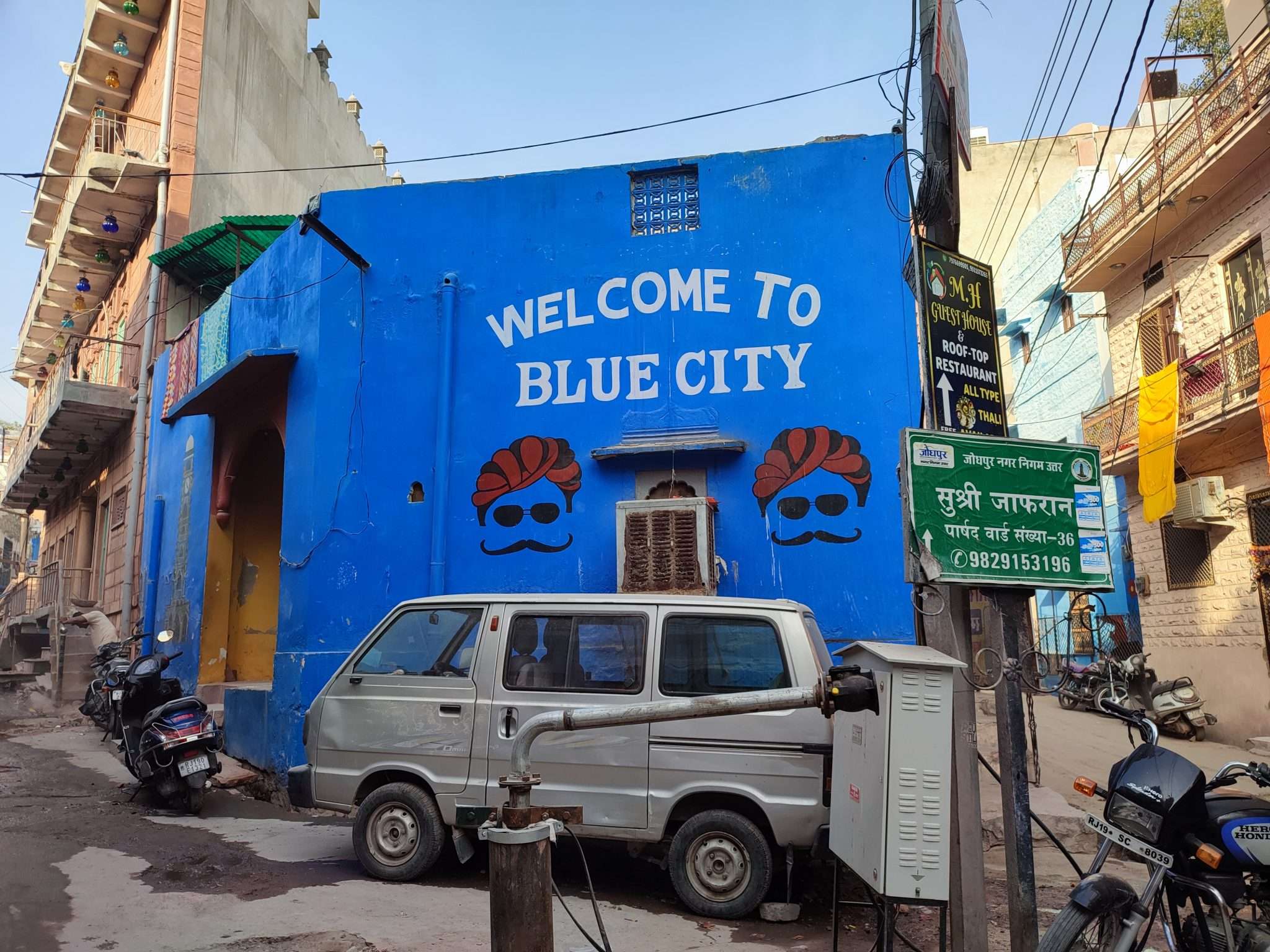
Yado nervously pacing back and forth from our hotel’s parking entrance to his car. Going down the steps and seeing him like this I understood that there was something bothering him.
After handing over the keys to reception I went up to him and asked what happened. With his index finger he points to a Tuk Tuk, to tell the truth it was more of a small van but for him it was easier to call it that. I look at the half-load of crates of water, I see that there are several people and a policeman in the street but I still don’t understand. I look again at Yado and he tells me that the van was left in the parking lot, without the handbrake on, and ended up against the gate of the building in front of the hotel. Result we can’t go out until the van is moved.
I reassure my driver, “there’s no hurry my friend, don’t worry”.
Jodhpur does not offer many attractions and in all probability the morning will be enough to visit them all, so why get caught up in the stress?
In fact, after just ten minutes the van was taken outside and we went out peacefully.
There’s a little bit of Indian culture in this episode, let’s say a legacy of old-fashioned Indian culture. For the generation of Yado, who is my age, every unforeseen event represents a mini-drama because the worry that comes with it is: who knows how many hours it will take before it is resolved? It would have been more logical for him to make me nervous, yet for him and for many there is this attitude, this tendency to drama, which clashes quite a bit with the problem solving skills they bring into play whenever necessary.
The clearest example of what I have just said is well represented by the crossroads which is located fifty meters from the hotel. It is banned due to an “artisanal” construction site and I’ll explain to you right away why I call it artisanal. I don’t know the reasons for this intervention, I mean that I don’t know the nature of the damage to the road or of these repairs, but the thing I have noticed is that the people who are working on it are not state workers or professionals from some company that he’s in charge of maintaining the roads: they are local kids, who work wearing flip-flops and who have grouped together and organized to fix a road which they most likely cross every day. If they had waited for the intervention of the public administration they probably would not have traveled it for a few years. This I mean by Indian problem solving.
Observing and listening to the people you meet around here, contradictions like these are quite evident and there are really a lot of them in very heterogeneous areas and in this post I want to try to tell some of them by inserting them in the diary of the day.
Our first destination was Mehrangarh Fort, the fort that I can see from the hotel’s rooftop restaurant.
It is an impressive fortification which dates back to 1459, although it has been extended and remodeled several times over the centuries. The ramparts are very high and the elevated position, in fact it stands on the highest hill of Jodhpur, allows you to have a dominant view of the area below.
The fort has seven entrance doors, although today only one is open and used. As soon as you cross the threshold, passing under a stone arch, you face a slight climb that leads to the ticket office, where you can buy an entrance ticket for 600 Rupees, just over 7 euros.
Another climb, this time longer and steeper, leads to the museum entrance where you can admire authentic pieces that keep alive the memory of the fort and of the people who lived and worked there. In its heyday it had over two thousand workers.
On the same floor, you pass in front of the Hall of Mirrors, an environment that I have also found in other fortifications and that I always like to admire.
The visit then continues with the Sala del Consiglio, the room in which the rulers listened to the problems and requests of the people. In one of these in particular I lingered for a long time because I found it wonderful. The inlaid wooden columns, the pure gold ceilings, embellished with paintings depicting divinities and members of the royal family, the walls decorated with motifs that are repeated throughout the room and whose upper part was created by inserting colored glass which, letting the light through, create a very fascinating play of reflections even with most of the windows closed and consequently in dim light.
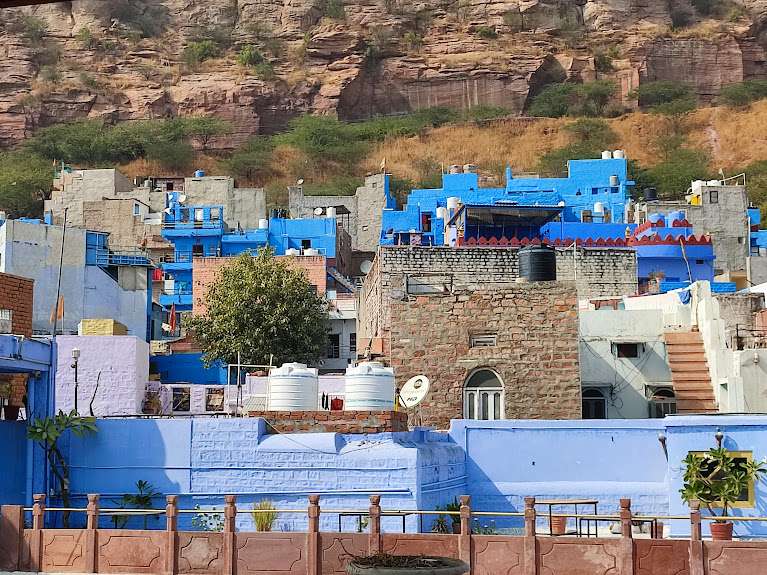
It was a short visit, lasting about an hour and a half, but which I’m happy to have included in my travel schedule because it also gave me the opportunity to take some photos from above and finally admire the blue roofs of the city. Visibility in this period is unfortunately not the best due to the humidity present in the air which creates a haze that disappears only in early spring.
Once out of the fort, head towards Achal Nath Shivalaya, the temple dedicated to the god Shiva which is a few hundred meters away and which can only be observed from the outside.
For the uninitiated in the Hindu religion there is a trinity consisting of Brahma, Shiva and Vishnu, where the first is the Creator, the second is the Destroyer and the third is the Protector. Shiva is therefore the one who destroys everything that has been created and has an enormous significance in the Hindu religion which considers destruction, in a broad sense even death, a source of renewal essential for life because without it the human species and any other living being, could not continue to exist. This temple is therefore important not only on a symbolic level, but also on an architectural level precisely to celebrate the fundamental role attributed to it.
The building was erected on the hill in front of the fort and is surrounded by a green area where there is a large lake which you can walk along to reach the temple.
As I slowly approached the steps leading to the main facade of this place of worship in which I have been interested for some time (don’t ask me why), I met an Indian guide who was explaining to the tourists entrusted to him the history and artistic particularities of each corner of the temple. One thing in particular made me stop in place to listen to his words. He said that when one enters a place of worship one has the natural tendency to go around the perimeter in a clockwise direction and that this is a mistake because in this way one discharges one’s energies in the place, while walking around it in an anticlockwise direction the same energies are absorbed by our soul.
Now, I don’t have the faintest idea of what the ratio of this statement is, nor if it has a foundation of truth, but when I come across this type of statements, customs, legends, I am always enchanted like a child in front of the magician .
In order not to look like someone who wanted to crash into another group’s guided tour, I accelerated my pace, overtaking the guide and effectively taking a different route from theirs.
A few quick shots and then I went back to Yado again to go back down to the city.
The third stop, the least interesting for my personal interests, was the Umaid Bhawan Palace, the largest royal residence in the world, according to the captions on the model found in the first room open to tourists.
The palace is still inhabited by the descendants of the first Maharaja and a substantial part of its 374 rooms have become a “two hundred star” luxury hotel.
I don’t know how you think, but I consider everything that revolves around nobles from all over the world a huge and colossal soap opera for people who need to believe in fairy tales and court stories to overcome boredom. And if we are dealing with extension cords, as Freud would call them, made up of buildings and properties that are ever larger, more extensive, more and more and more… well, my interest reaches full scale. This explains why I took two photos throughout the visit and I certainly won’t regret this.
Lunchtime, Yado is up to you, clean, nice and eat well.
He turns around while inserting the car key and says to me: “Sir, the best place is the hotel’s restaurant, rooftop, good food, cheap price”. Great performance Yado, you convinced me Yado, let’s go!
We go down the hill, we enter the city and at a certain point, while we are near an intersection, a very narrow crossroads, we get stuck with another car and two Tuk Tuks. I’m posting the photo because you have to see it with your own eyes. I was about to open the door and go down to continue on foot because I didn’t see any concrete possibility of being able to get out without the help of some explosive material. Yado looks at me, understands that I’m amazed and smiles slyly. Sir, it’s like this, two minutes and we’ll be fine. In fact, after one hundred and fifteen maneuvers we came out unscathed.
We take the road that leads to our hotel and when we are one step away from the entrance we find 4 cows lying in the middle of the road that have no intention of moving to let us pass. A boy who was a few meters from the car tries to get them to move but they were just fine where they were, Yado opens the window, laughs, yells something to the cows, then honks the horn, nothing to do the ladies don’t want any know to get up, then the owner of the shop who is on the curve intervenes and evidently is familiar with these situations and shouts a couple of Indian words in a convinced voice that have the desired effect. Free road, finally we are at the hotel.
So I enjoyed lunch in the sun, listening to music playing on my phone and enjoying a much needed couple of hours of relaxation.
In the afternoon I planned to wander aimlessly through the alleys of the old city, to breathe the most authentic atmosphere in the area less frequented by tourists.
Maybe I was a tad too enthusiastic about breathing, in these parts the air isn’t exactly clean and it often happens that I feel the need to put on a mask to filter it at least a little.
When I decide to venture into areas like these, if the context permits it in terms of safety, I intentionally get lost. It is an achievement that I easily obtain by taking the main road and taking 5 secondary roads in an absolutely random way, to the right and to the left. At that point I no longer know where I am and I begin to follow colours, smells, noises and anything that catches my attention. Of course, at any time I can open Maps and find my way home, so I’m always able to find myself, mind you. But what I can see and discover in this way I like so much that I consider it my favorite sport.
Today in this way I discovered an area of itinerant stalls that cooked all kinds of local street food, a covered market of fabrics, another only of spices and a series of artisan shops of all kinds that were immersed in their daily activities. An extremely authentic cross-section of the city.
In these timeless places, where crafts have been handed down over the centuries and whose knowledge is taught from father to son, I took some photographs with both my eyes and my phone that I am satisfied with. I’m not referring to the quality of the photos, I’m an amateur photographer who has no awareness of what a camera can do and the smartphone is not the most suitable tool for taking high-level shots. I am referring to the satisfaction of having immortalized a moment that had a meaning for me and of having caught it in the very moment in which it presented itself in front of me, just as my eyes saw it. Looking back at these photos over the next few months will make me travel through time and take me right back to where I am now, bringing with it the feelings I’m having.
In one of these moments I saw a father teaching his son his art, a child who independently managed an incense shop whose scent made me stop on the spot to immediately buy two packs.
I came across pasta shops, yes really pasta, which has nothing to do with ours but which I would have loved to taste in a local recipe, which unfortunately I won’t be able to do.
I photographed a very strange shop, a hole in which all kinds of junk were collected, very dirty and very messy, but in its absolute incomprehensibility it had a unique charm and gave me the impression of being an Indian vintage products shop. I’m sure I’m wrong, but that’s the impression it gave me. In any case, the wonderful thing beyond all limits of this stretch of walk was the smiles of the people, all of them, who met my gaze even if only for a few seconds. Of some I took a photo, asking permission first, of others I just smiled back, but I felt welcomed with warmth and affection and this is not something that is easily found when travelling.
Looking around I realized that I had recognized a street I had passed yesterday with Yado and I realized that I was heading in the direction of the Clock Tower, then towards the main square where the market is and further on the hotel. So I decided to change direction and slipped into a very narrow tunnel, a fast track as some call it here, which connects two larger roads. Inside, the sellers are so close to each other that the goods overlap with those of the neighbor and create a single counter that reaches the end of the gallery. I needed a pair of slippers because I forgot mine in the hotel in Jaipur and placing the soles of my bare feet on the floors of these hotels is not even talked about, so as soon as I found a shoe seller I glanced for see if he had anything that suited me.
Bingo, he had slippers of all kinds and as soon as he detected my interest he started showing off his entire repertoire showing me the most valuable pieces. I’m being ironic, his attitude was really like this too. Moreover, I bought a pair of branded flip flops for three euros, certainly fake but well made. The highlight of the purchase though was when he showed me his Facebook flip flops, I laughed and if he had my number I would have bought them instantly, I swear. In a place like that, on a sandy street, in a city where the illiterate rate is unfortunately still high, seeing the fake slippers on a social network made me think again about the contradictions of this country.
Another thing I find incredible, and allow me to say also unacceptable, is that motorcycles can pass through that tunnel, no more than two meters wide, crowded with crazy people.
For me it is the clear sign of a demographic growth that is not going hand in hand with the cultural growth and civilization of the population.
The UN predicts that India will reach China’s population by 2025 and that by 2064 its population will be exactly double the number of Chinese. These are forecasts that give goosebumps because, as I said before, unlike China, this growth in India is not managed and supported by the government, or at least the feeling is that there is still much, too much to do and that we have already late.
I continued the walk and returned to the hotel but on the way I stopped to observe with admiration a banquet which was preparing the Masala Dosa, a roll stuffed with onion and spices which was under siege by dozens of people and in which the main rules of hygiene were completely ignored as well as violated. The boy who was in front of the plate handled all the foods with his bare hands, after touching money and shaking hands left and right. The plate itself was wiped clean with a tea towel which was of every possible color except white and which, I am sure, contained at least six generations of different bacteria.
The skill with which he rolled out the dough, measured out the ingredients, waited for the cooking times to always obtain the exact same result, made me fall in love with that situation so much that I wanted to throw myself into buying a roll. Then I recovered from the euphoria and regained the lucidity necessary to be satisfied with the video I recorded, in front of customers who looked at me as if I was the weird one J
Back at the hotel, I relaxed a bit, had another dinner on the rooftop and now I’m in my room writing today’s story, happy with these two days full of smiles, emotions and memories.
That’s all for today, see you tomorrow.